
(Originally written for the Scottish Freelancers Ensemble newsletter, 28 November 2020)
Back in Summer 2019, Scottish Freelancers Ensemble co-founders Alice Allen and Katrina Lee (AKA the then newly-founded Gaia Duo) approached me for some advice about tunes written by female composers during Scotland’s “Golden Age” of Scottish fiddle music of the late 18th and early 19th centuries. Alice and Katrina’s project centred around championing works by female composers, particularly reviving the work of lesser known musicians from Scotland.
In Scottish music, there is evidently still a long way to go in terms of gender balance and equality, but there is no denying that women make up many of the great fiddlers and tune composers active in trad music today. On the other hand, if you ever read any of the “histories” of Scottish fiddle music, it would seem that before the last quarter of the 20th century this was an entirely male-dominated scene. The history of the Scottish fiddle tradition is not only about music and the various ways in which it is played, but centres on the lives and careers of its founders and creators: the Gow family, Robert Mackintosh, Simon Fraser, William Marshall, James Scott Skinner – the “Great Men” of Scottish fiddling.
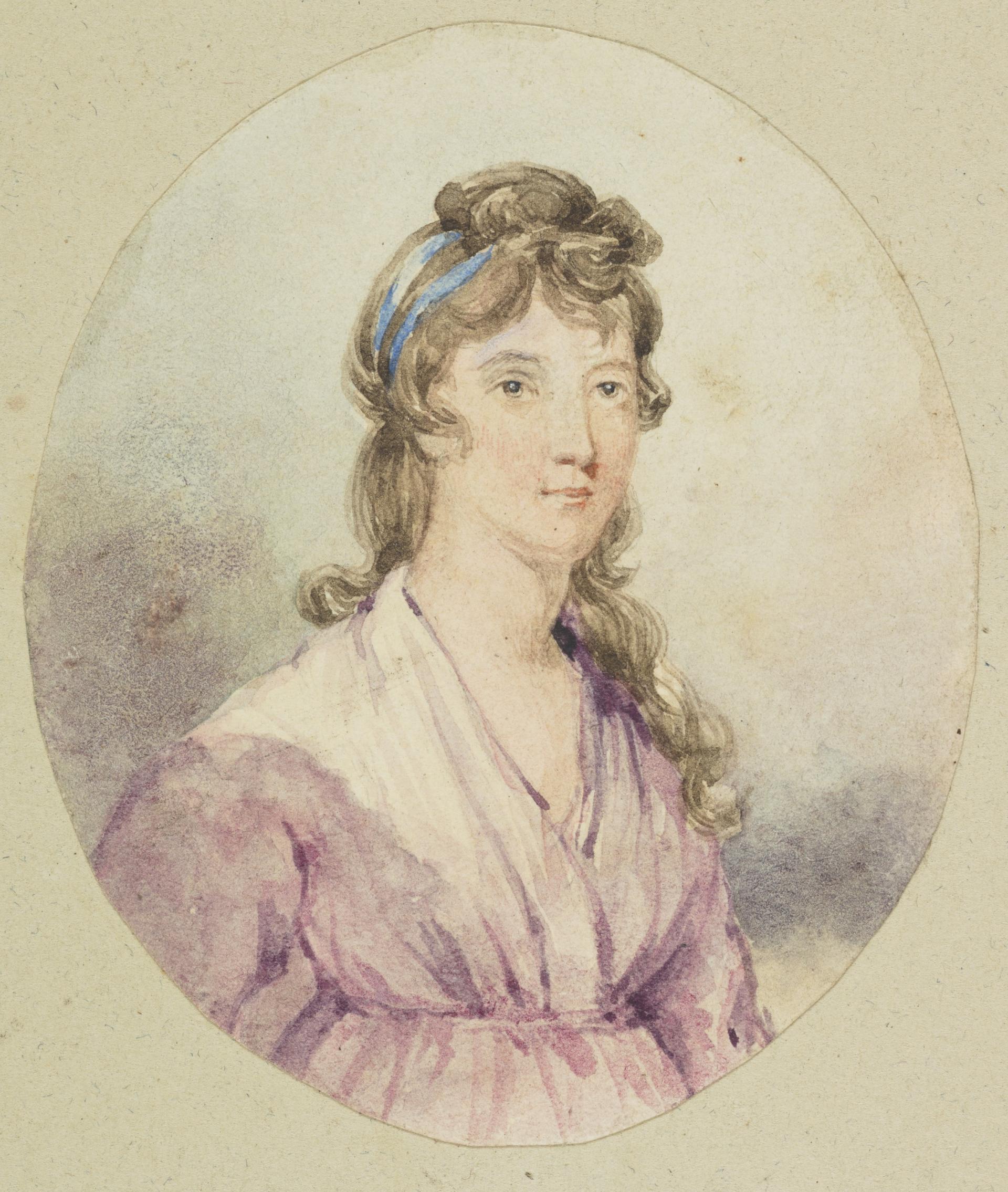
Euphemia Murry of Ochtertyre (1769-1845), noted fiddle tune composer and dedicatee of Robert Burns’ song “Blythe, blythe and merry was she”.
My PhD research looked at the early history of the violin in Scotland, and in many ways attempted to challenge the orthodoxy. I uncovered a far richer story than had previously been known – one stretching back far earlier and with more cosmopolitan roots. It is clear that more than any other instrumental tradition in Scotland, the violin / fiddle was (and is) defined by its ubiquity: by the 18th century it was played across class divides, used across different styles, and was known in every corner of the country. Experts have long insisted that there were strict gender divides in choice of instruments and music making in the period, between professional and social activities for men, and more solitary music-making (keyboards, plucked instruments, solo song) for women. Nevertheless, I kept coming across early evidence to the contrary – records of violin lessons given to young women; important fiddle manuscripts compiled by or for young ladies; and even relatively well-known amateurs like Elizabeth Rose of Kilravock, whose music making at Kilravock Castle (Nairnshire) included wide-ranging repertoire from chamber and orchestral music through to Scottish fiddle tunes.
Into the late 18th century – the “Golden Age” of Scottish fiddling – women were actually far more represented in tune collections than would seem likely from reading the literature. In carrying out research for the Gaia Duo, I found dozens of examples of volumes containing tunes by female composers, including several collections entirely consisting of tunes by one or more Scottish women.
Some of these individuals were specifically named. For example, Magdalene Stirling of Ardoch (1766-1846) seems to have patronised or befriended a number of Perthshire musicians, and her tunes were printed in several collections by the Gow family and the dance musician John Bowie. Stirling was a member of the Perthshire Gentry (her father was the 4th Baronet of Ardoch, Strathallan), and in c. 1810 she published a collection of her own tunes, including the popular strathspeys Duneira Lodge and Perthshire Hunt.
Perhaps the most important reason women have not been included in the official early history of Scottish fiddle music is their anonymity: most tunes by women and even whole collections were not attributed directly to individuals, but anonymously, to “a Lady” or “a female amateur”. Nevertheless, in one case a bit of detective work has uncovered some information on one of these anonymous female composers.
The volume in question is a collection composed by a “Young Lady” and published by Urbani and Liston in Edinburgh in 1804:
A Collection of Original Strathspey Reels, with Variations, Waltzes, Marches, Irish Airs & Co. and A New Sonata for the Piano Forte, Violin or German Flute.
A perusal of the contents of this volume shows that the “young lady” was a talented composer of sophisticated music. The collection has an impressive scope of contemporary traditional styles, including variation sets on Scottish tunes with difficult pianistic writing, a skilfully-handled range of dance forms and military pieces, and tunes in the style of Scottish and Irish national airs. The collection opens with a three-movement ‘Sonata’ which effectively merges ideas from classical-era sonata form and vernacular idioms. An opening march marked Maestoso is in rondo form, featuring a recurring melody evoking the sound of trumpet calls. The second movement opens with a song-like Andantino, based on a theme in the style of a Scots tune, followed by ten art-music style variations, variously setting the tune with different accompaniments, rhythmic figuration, melodic divisions, and a shift to the minor key. The Finale is thematically related to the slow movement, but in a faster Allegretto, evoking the feel of a country dance or reel.
The best clue to the identity of the composer is a note on the title page that the collection was ‘entered into Stationers Hall’, the legal deposit libraries that functioned as the copyright of the day. Whilst many publishers made this claim without entering a copy of their book, fortunately this volume was entered, on 17 August 1804 by one Catherine E. White, presumably the anonymous ‘Young Lady’ composer.
A search for known composers, publishers, or musicians with the name has not revealed any information, nor are there any obvious candidates in Scottish Old Parish Records of marriages, births and deaths. However, an intriguing possibility is that Catherine E. White was one of the ‘Misses Whites’ apparently responsible for the tunes in another volume, published by Gow and Shepherd in Edinburgh in c. 1800. Its full title page reads:
A Collection of entirely Original Strathspey Reels, Marches, Quick Steps, & c. for the Piano Forte, Violin, German Flute &c. by Ladies resident in a remote part of the Highlands of Scotland. NB. Corrected by Nath. Gow.
An annotated copy belonging to J. Murdoch Henderson (now held at the University of Aberdeen) includes a pencilled note that the “Ladies” were the “Misses White, Brockly”, and another copy owned by Kidson now at the Mitchell Library, Glasgow also refers to the composers as “the Misses Whyte”. Presumably this was the family referred to in several tunes in this volume: “Miss M. White of Brachloch”; “Miss White of Brachloch’s Strathspey”, and “Capt. White 73rd Regts. Strathspey”. Brachloch, or Brackloch is the historical name for a small village on Lochinver, Sutherland, 90 miles northwest of Inverness. Easiest to trace amongst the Whites named in the tunes is ‘Capt. White’, almost certainly a reference to Captain William White of the 73rd Highland Regiment of Foot, author of Journal of a Voyage performed in the Lion Extra Indiaman (London, 1800), a travel diary written during his time in India and Africa.
The argument for the common authorship of the two tune collections is strengthened by their tune titles, many of which are named for upper class individuals from the North Highlands, Moray, and North Aberdeenshire. Whilst there are no specific overlaps of tunes between the collections, several individuals or families are named across both collections, including the Macleods of Geanie (Tain), the celebrated musical family the Roses of Kilravock, and members of the family of the Duke of Gordon, several of whom were important amateur musicians and patrons, most notably to the fiddler-composer William Marshall (1748-1833). Whether these individuals were friends or patrons of Catherine White, she was clearly not only a skilled composer, but someone intimately connected to Scotland’s musical elite, including important amateur musicians, publishers, and other fiddler-composers from the “Golden Age”.
Hopefully rediscovering the identity and music of Scotland’s anonymous female tune composers will go some way to ensuring that the history of Scotland’s “Golden Age” of Scottish fiddling is no longer entirely male-dominated. In the meantime, check out many of the original collections at the National Library of Scotland’s digital collections (https://digital.nls.uk/special-collections-of-printed-music) and listen to Gaia Duo’s live recording of some of Catherine White’s music here: https://www.gaiaduo.com/media.
Aaron McGregor 28 November 2020
 aaronmcgregor